The Devil’s Roses
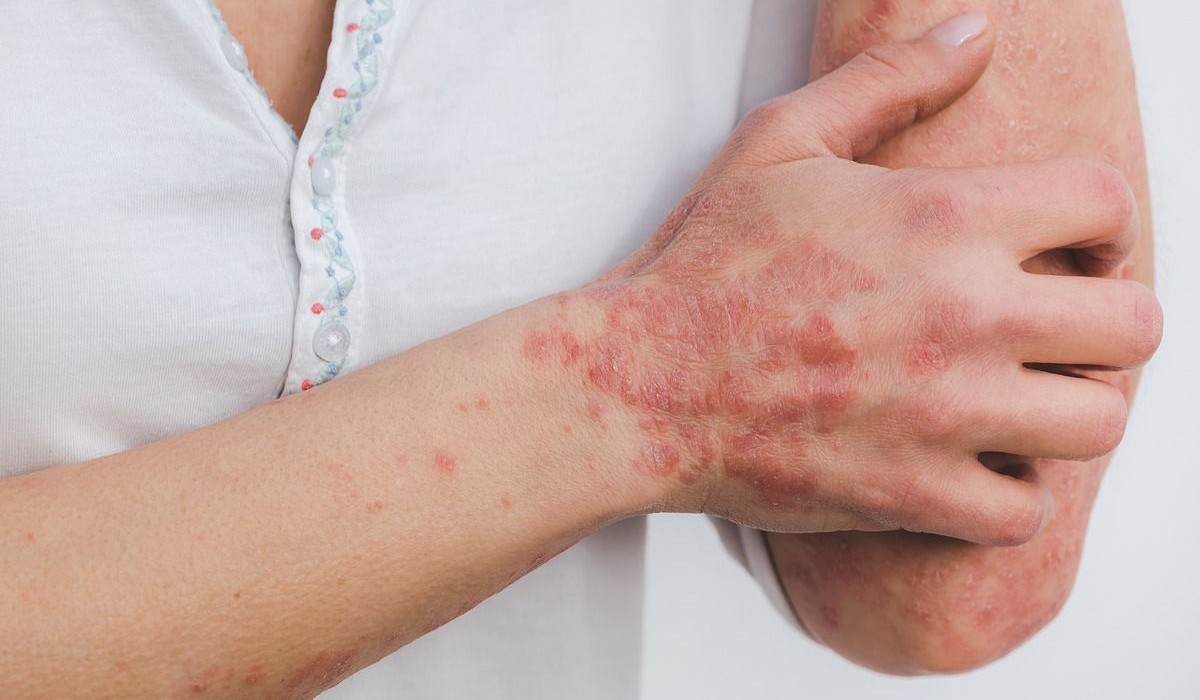
At first glance, one might think this is about beautiful flowers, but it is not… In the Middle Ages, psoriasis was called “the devil’s rose.” Psoriatic plaques can have bizarre shapes, a bright red or pink color, and a scaly surface, which from a distance can be mistaken for a “flower.” Since the cause of psoriasis was unknown and its occurrence was unpredictable, people with such skin manifestations were considered either marked by evil spirits or chosen ones.
The term “Psoriasis” originates from the Greek words psora (itch, scabies) and -iasis (condition, process). The term was first introduced by Hippocrates to designate any itchy skin diseases. In 1841, Austrian physician Ferdinand von Hebra identified psoriasis as a distinct disease. It was previously believed that psoriasis was contagious and that patients needed to be isolated. After Hebra’s work, the myth of the “contagiousness” of psoriasis was debunked.
Psoriasis (scaling-lichen) is a chronic, non-infectious skin disease. The disease is characterized by periods of exacerbation and remission. Psoriasis can occur in both men and women, though women are affected more frequently. According to the World Health Organization, about 2-3% of the world’s population suffers from psoriasis.
History knows prominent figures in politics with this condition, such as Winston Churchill and Joseph Stalin. The first dollar billionaire, John D. Rockefeller, and the writer Vladimir Nabokov also had it. Some were ready to erect a monument made of pure gold, while others offered a prize equal to the Nobel Prize for the invention of a cure for psoriasis.
Many modern stars, including Kim Kardashian, Cara Delevingne, Cyndi Lauper, and Britney Spears, openly talk about their experience of living with psoriasis and their methods of fighting flare-ups, and participate in educational campaigns about the disease. Currently, there are international organizations (IFPA, IPC) and large national foundations (NPF) that help people with psoriasis and psoriatic arthritis.
Little has changed since the Middle Ages in understanding the cause of the disease; it remains unknown. However, a number of predisposing factors in the occurrence of psoriasis have been identified. Hereditary predisposition is one of the key factors; nevertheless, it is not a 100% guarantee that children will develop this disease. The next equally important factor is the presence of foci of chronic infection. Particular attention is paid to the stress factor, since stress can not only lead to the onset of the disease but also actively maintain inflammation in the skin. The endocrine factor in the development of psoriasis is also highlighted. Hormones secreted by our body (estrogens, thyroid hormones, androgens) have a significant impact on the proper division, growth, and metabolic processes within skin cells. If there is a malfunction in the endocrine system, it can also influence the development of psoriasis.
Several forms of psoriasis are distinguished: vulgar (common), exudative, guttate, and psoriatic arthropathy. Sometimes, patients with psoriasis notice a link between flare-ups and a specific season of the year. Thus, if exacerbations occur most often in the summer period, it is the summer form; if in the winter, it is the winter form; there are cases when flare-ups do not depend on the season, and such a form is called out-of-season.
The disease manifests itself by the appearance of papules and plaques of various sizes on absolutely any part of the body. The plaques are clearly demarcated from healthy skin, and the color of the elements varies from pale pink to bright red. In severe cases of the disease, plaques can merge with one another, covering extensive areas of the skin and making the process universal. The rashes are accompanied by itching and pronounced peeling of the skin, in which the scales have a characteristic silvery color. The eruptions are accompanied by a feeling of dryness and tightness. If the plaques are localized in natural folds (elbows, knees, fingers), complaints of cracks and pain are often present.
In addition to the skin, nails and joints can be affected. Nail involvement manifests in the form of onycholysis (detachment of a part of the nail or the entire nail plate from the nail bed), the “thimble” symptom (pitting), onychodystrophy, and the “oil drop” stain. When joints are affected, the joints of the hands, elbows, and knees are usually the first to trouble patients; often, patients complain of discomfort in the hip and shoulder joints. Complaints of joint pain are very frequently characteristic of psoriatic arthritis. The diagnosis is established by rheumatologists after additional follow-up examination. Asymmetry of the process is typical for psoriatic arthritis.
Many patients believe that to establish a diagnosis of “Psoriasis,” it is necessary to pass many tests. However, this is not the case. The most important thing for diagnosing psoriasis is the doctor’s eyes. For an experienced doctor, making a diagnosis of “Psoriasis” poses no difficulty. There are rare cases when dermatologists may doubt the correctness of the diagnosis; then procedures such as dermoscopy and skin biopsy come to the rescue.
During the study of psoriasis, many treatment tactics have been developed, both medicinal and conservative. Physiotherapeutic treatment and sanatorium-resort treatment come to the rescue. For a more comprehensive therapy, specialists such as rheumatologists, general practitioners, psychotherapists, and nutritionists join the treatment.
Skin with manifestations of psoriasis requires special care. It is very important to understand that skin with psoriasis is prone to increased dryness, which means that factors such as hard water, dry air, weather conditions, and the use of aggressive cleansing cosmetics can lead to even greater dryness of the skin, the formation of microcracks, and irritation, which can lead to another flare-up. The skin should be cleansed with mild oils and gels that do not contain aggressive surfactants. After bath procedures, it is mandatory to moisturize the skin with emollients. Use shampoos with tar, naphthalan, and herbal extracts (celandine, succession). These components reduce peeling and itching, soften the skin, and help relieve irritation.
If we talk about the most modern and high-tech method of treating psoriasis and psoriatic arthritis, it is definitely biologic therapy (biologics / genetically engineered biological therapy). For more than half a century, scientists around the world have been studying and developing biotechnology. In 1975, Georges Köhler (Germany) and César Milstein (Argentina) received the Nobel Prize for developing a method for producing monoclonal antibodies in the laboratory. This discovery laid the foundation for the creation of biological drugs.
October 29th is World Psoriasis Day. The main purpose of this day is to raise awareness about the disease, support patients suffering from this condition, and build commitment to treatment and compliance with the dermatologist’s recommendations.